


{ Photo by Galie Photography }
People sometimes ask: How can I make my cookies as perfect as the ones from your bakery? I’m using your recipe, but I can’t replicate the taste I remember from Lola’s — or the appearance in your photos.
My answer is that baking cookies is an exacting science; small things make a big difference. Over the years I’ve learned this the hard way. Here are my top eight tips, so you can skip the learning curve and go straight to the awesome.
1.Baking Is Not Like Cooking!
When you cook you can add in “some” of this and “a bit” of that. Even if you change direction halfway through a dish, it still may turn out great. This seldom works in baking.
Professional bakers sometimes call recipes “formulas,” and for good reason. Baking is all about the chemical reactions that take place once your concoction is in the oven. You must set things up right or things won’t work the way you want.
Whenever you get a new recipe, follow it exactly the first time. Don’t substitute, don’t modify the instructions, don’t omit anything. You need to establish a “control” so you can decide what — if anything — you should tweak.
Then, when you start changing things, write down your adjustments and note the results. After experimenting a bit, you will see what direction to go.
If you’re used to the more improvisational style in cooking, you may not like baking at first. I’ve come to love the structure, and I like knowing where it’s OK to adapt and where I must toe the line.
2.Measure by Weight
Many home bakers measure dry ingredients by volume — in cups and tablespoons. But I urge you to measure by weight. A good kitchen scale will make you a better baker.
Baking is all about precision. The same amount of flour or sugar may have a different volume on different days, depending on the humidity and your method of scooping. Besides, weighing is faster: No need to pack brown sugar or to level each cup as you scoop if you are weighing it, just dump it in a bowl in the scale until it reaches weight and you’re set.
My recipes list the major dry ingredients by weight. (I still do spices and the like by teaspoons and tablespoons because it’s not practical to weigh them for home-baking batch sizes.) I usually supply a volume equivalent; many Web sites have weight-to-volume converters, too. But using a scale is best.
3.Can I Use This Other Flour?
You have flour in your cupboard — just not the exact type called for in the recipe. You don’t want to go shopping. Tempting, right? Please resist.
Remember, baking is science. Different flours have different amounts of gluten, plus other qualities that can change the texture and structure of your finished baked goods. Maybe you’ll get lucky, but more likely you’ll be unhappy with the results.
4.Know Your Oven
The temperature in many ovens is 10-25 degrees different than the oven’s readout. Use a cheap oven thermometer (available in most grocery stores) to check your own oven; you may be surprised by the results.
Also, each oven simply performs differently. All my recipes used to be calibrated for my bakery oven; now that I’m baking at home, I’ve needed to re-calibrate temperature and time slightly. I’ve published the times that work for my particular home oven, but your results may be different — so check your baked goods toward the end, and see how they’re doing. If they take a slightly longer or shorter time, make a note on the recipe.
(Remember that item size affects times, too. If you scoop your cookies bigger or smaller, they may take more or less time to bake.)
Finally, does your oven have “hot spots”? In many ovens, the bottom rack of cookies may brown faster than than the middle or top rack. Or maybe the cookies at the back of the oven will brown faster than those at the front. What to do? Just rotate the trays during baking.
5.Convection? Probably Not
Should you use the convection feature on your oven? In my experience, I do not trust this feature on home ovens for cookie baking.
At the bakery I had a beautiful convection oven; I miss it terribly. But commercial ovens are bigger, and the air flow is nice and even. Home ovens don’t seem to work as well.
My recipes here all assume non-convection baking. If you do use the convection feature on your oven, set the temperature 25 degrees lower than my recipe says.
6.Scoop Like a Pro
For consistent results, bake a consistently sized, consistently shaped cookie. The easiest way to do this is to use an affordable standard-sized scoop.
Did you know that professional scoops come in industry-standard sizes with different color handles? Three sizes cover all the cookies I make: The yellow-handled #20, the red-handled #24, and the purple-handled #40.
7.Use The Right Baking Trays
What kind? Heavy aluminum baking pans with rolled edges are the best, in my opinion, and they are generally what the pros use. They heat evenly and last forever, all for a reasonable price. I have two sets at home: One set exclusively for baking, and another for everything else (roasting vegetables or broiling fish, for example).
If your oven has three shelves, I recommend buying four cookie baking trays. That way the next pan is always ready to go when you remove one from the oven. Efficiency!
Does anyone “grease” baking trays any more? Seems like everyone I know uses silicone mats or parchment. Either is fine; I prefer parchment because it leaves no residue on the baked goods and it’s easier to clean up.
8.Chill The Dough
This is indispensable advice for sugar cookies: Chilling the dough is the only way to get nice sharp edges on your cut-out shapes, rather than the more amorphous, spread-out look that comes from warm dough.
Many bakers also believe that chilling the dough overnight will improve flavor for chocolate chip cookies and other “drop” cookies. I chill these doughs mostly for convenience. It makes the job easier the next day if I’ve already made and scooped the dough and stored it in a container.
After removing the dough from the fridge, I put the pre-scooped balls on a baking tray to soften for about 20 minutes while the oven warms up, then I bake them off.
Does this improve flavor? Do your own taste-testing experiment and tell me what you conclude: That’s science at its tastiest!

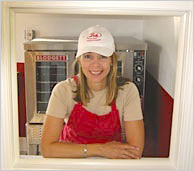 From 2002 to 2013, Lola's was an award-winning, all-scratch cookie and cupcake business. Now I'm sharing my recipes with our wonderful customers and fans.